
THE BREAKTHROUGH LEADERSHIP ARCHITECTURE
The Breakthrough Leadership Architecture
Leadership has an architecture
Why do capable leaders plateau?
Why does something that has worked for years suddenly stop working?
And why do some leaders continue to grow with increasing responsibility while others find that the very qualities that made them successful begin to get in the way?
LEADERSHIP DEVELOPMENT
Most leadership development focuses on behaviour: what good leaders do.
The Breakthrough Leadership Architecture looks beneath behaviour, at how the leader develops as a human being — and how that development shapes their capacity to lead.
THE LEADERSHIP ARCHITECTURE
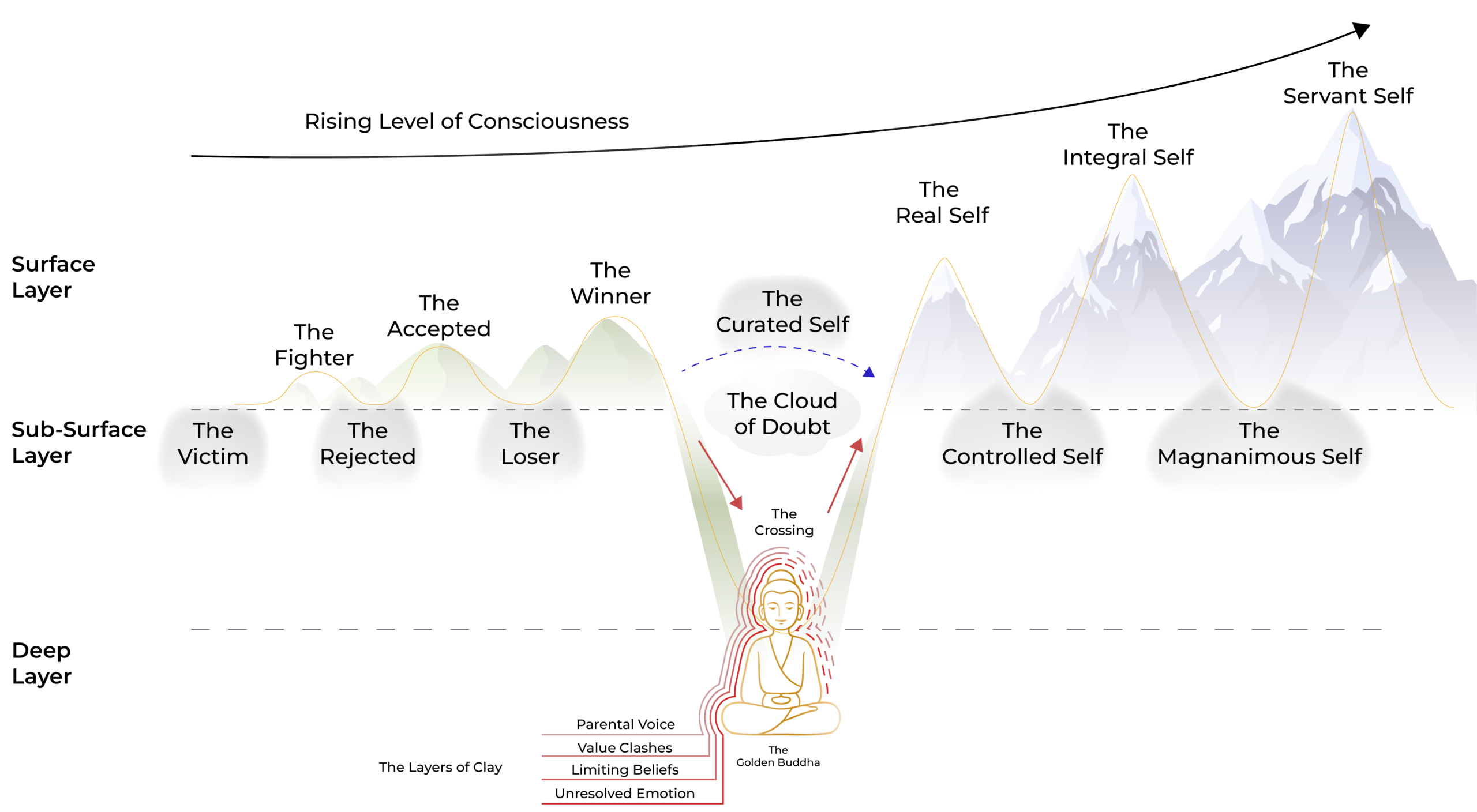
The Leadership Architecture
01
The Three Hills — Surviving → Belonging → Competing
These describe the developmental journey through which independence, capability, judgement and ambition develop. For many successful leaders, considerable professional achievement occurs at Competing. But the strengths that created success can eventually become constraints: determination becomes control, confidence becomes the need to be right, and carrying responsibility becomes an inability to give it away.
02
The Valley — Breakthrough / Individuation
The next stage requires a different journey. Breakthrough separates who we are from what we have accumulated — experiences, emotional responses, beliefs and ways of protecting ourselves. As that interference reduces, choice returns. Individuation is not becoming somebody else. It is becoming more completely yourself.
03
The Three Mountains — Self-mastery → Mastery with Others → Mastery through Others
Beyond Breakthrough, development changes again. Authentic leadership begins with a clearer relationship with self. Integral leadership develops the capacity to hold greater complexity and allow other capable people to lead. Servant leadership moves the centre of gravity from personal achievement towards stewardship — what the leader can enable others to achieve, including after they have gone.
“What kind of human being can steward increasing responsibility?”
WHY THIS MATTERS
Why this matters
01
Success and development are not the same
Success can hide a developmental plateau. What got you here may continue working for quite a while. Until it doesn’t. Your shareholders may feel it before you do, and what happens to your tenure then?
Success is evidence that something has worked.
It isn’t evidence that it will continue to work or that you have continued to develop.
02
More of the same won’t get you off the plateau
You already know how to push harder. More effort. More determination. Higher standards. More pressure. But you already have pressure. Eventually, more pressure produces less, not more.
The next stage of development isn’t necessarily another climb using the strengths that brought you this far.
Sometimes, to go higher, you have to go down first.
That’s the valley in the map.
03 / WHY THIS MATTERS
Your organisation cannot outperform the person at its centre
Life and business are too complex and too fast-moving for one person to have all the answers. The challenge is no longer to know more than everybody else. It is to create an organisation in which other people’s intelligence, judgement and initiative can flourish.
That requires a genuine shift from me to we. It cannot simply be performed. People know when empowerment still means control. They know when authenticity is carefully curated. And they know when service still leaves the leader at the centre.
Without trust, people protect themselves. They wait for decisions. They tell the leader what the leader wants to hear. The organisation becomes limited by the person it most depends upon. But the opposite is equally true.
A leader who trusts capable people, gives away responsibility and creates the conditions for others to flourish can achieve far more — without personally doing more.
That isn’t the organisation outperforming its leader. It is the leader performing at a higher level.
The best leadership can be being, not doing.

BEGIN
Let’s Talk
You don’t need to know exactly what’s holding you back before we speak.
We can start with a confidential conversation about where you are, what’s happening and what you’d like to change.
If I believe I can help, I’ll explain how. If I don’t, I’ll tell you.